
How are a chip and a pitch different?
A putt usually rolls along the green. A chip often has a short, lower flight followed by more roll. A pitch often spends more of its journey in the air, with less roll afterward. These are useful patterns, not fixed rules for every club or lie. A lie means how and where the ball rests. Keiser University College of Golf explains chip and pitch.
Look at the landing space and the room for the ball to roll. You can describe that situation to an instructor without deciding on your own that one stance or swing length fits every shot. This guide does not prescribe a flight-to-roll ratio.
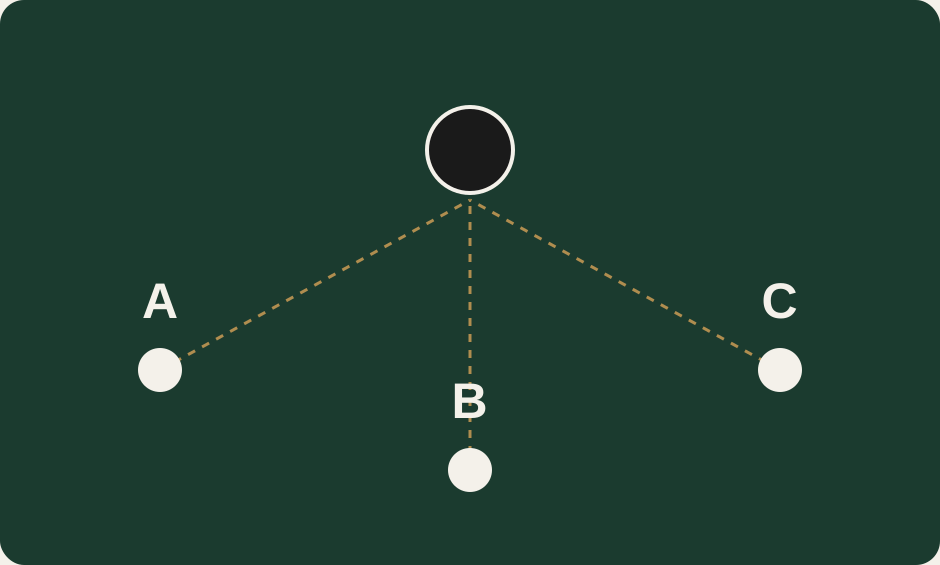
Try a three-spot putting game
On a permitted practice green, choose three short starting spots around a hole. Take one putt from each. Score one point for each ball holed, for a score out of three. Repeat from the same spots if the space is available.
Record your own result rather than treating a score as a pass or fail. This is a JAMY PRO editorial practice game, not an efficacy-tested improvement program. Share the space and move on instead of occupying one area for a long session.
Practice areas need care and recovery. Follow the facility’s signs and use only the areas open for practice. USGA guidance on protecting practice areas.
One hole, three starting spots: A, B and C
Can you leave the flagstick in?
The flagstick is the pole in the hole.
Yes. R&A Rule 13.2 allows you to choose to leave the flagstick in or have it removed, with the choice made before the stroke. Ordinary contact with a flagstick you chose to leave in normally has no penalty. Do not deliberately move it off-center for an advantage, or move it to affect a ball already moving. Unusual situations have additional details in the rule. Read R&A Rule 13.2.
If your group is unsure about an unusual situation, check the actual rule or ask the person running play rather than extending this short summary to every case.
Keep exploring
Source links support the specific facts beside them. They do not imply endorsement of or affiliation with JAMY PRO. Planning questions and examples are our editorial suggestions, not personal instruction or result promises.