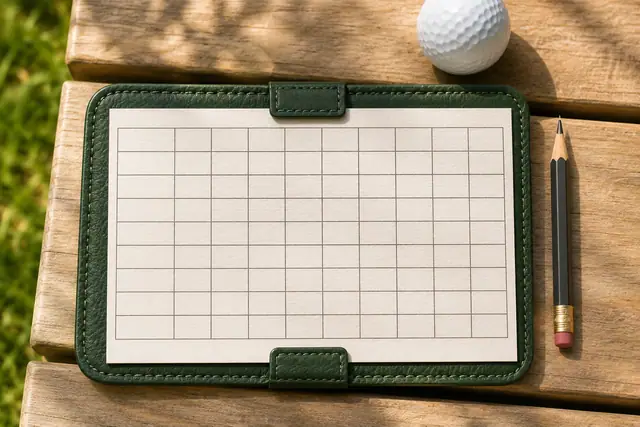
Which rows do you look for?
The hole number tells you where you are playing. Tees are the starting areas for a hole. Distance rows can match different sets of tee markers, so find the row for the starting areas you are using. Par is a reference score based on expert play, not a beginner pass-or-fail test. USGA’s explanation of par.
In ordinary stroke play, your score for a hole includes the strokes you took and any penalty strokes. Write that score in your own score row, not in the printed par row. Other playing formats can use different scoring arrangements. R&A Rule 3 explains forms of play.
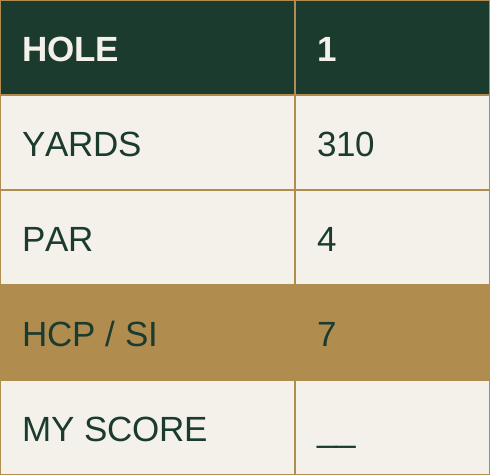
| Row | Hole 1 | Meaning |
|---|---|---|
| Hole | 1 | The hole being played |
| Yards | 310 | Example distance for one tee set |
| Par | 4 | The reference score |
| My score | 5 | Strokes plus any penalties in ordinary stroke play |
What do birdie, eagle and bogey mean?
These words compare a score with par: a birdie is one stroke under par, an eagle is two under, and a bogey is one over. On the example par-4 hole, those are scores of 3, 2 and 5. AIG Women’s Open golf terminology.
First work out the actual score. The name is a way to describe its relationship to par, not a separate number to add to it.
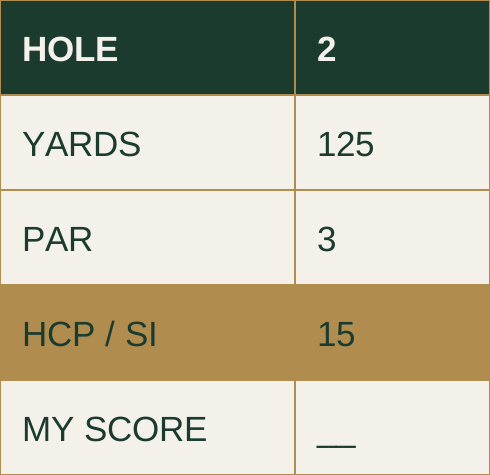
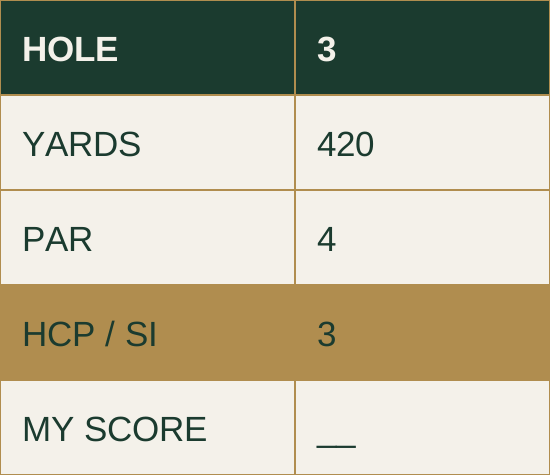
Fictional card: one hole per panel. Yards are distances for the example tee set. HCP / SI is the handicap stroke index, not the score you took. “My score” is deliberately blank.
Example hole 1
Example hole 2
Example hole 3
What does HCP or SI mean?
Handicap strokes are adjustments used to help golfers with different abilities compete. A row labeled HCP or SI helps allocate those strokes to holes. It is not where you write your actual shots and is not simply a list of your hardest holes. USGA’s stroke-index allocation explanation.
Card layouts vary. Ask the golf shop or your playing group to point out your tee-distance row, score row and any competition instructions. You do not need to invent a handicap calculation to fill a practice note.
Keep exploring
Source links support the specific facts beside them. They do not imply endorsement of or affiliation with JAMY PRO. Planning questions and examples are our editorial suggestions, not personal instruction or result promises.